ASEAN: Music’s Next Frontier

Southeast Asia’s music industry is evolving at a remarkable pace. As ASEAN’s artists reach new audiences across the region and beyond, Europe’s attention is only beginning to catch up.

When talking about Asian music, the conversation almost always begins with South Korea or Japan. Over the past two decades, K-pop has become a global phenomenon, while Japan has long remained one of the world’s largest music markets. Together, they have shaped the way international audiences perceive Asian music, often leaving little room for the rest of the continent.
Yet beyond these two powerhouses, another region is quietly reshaping its own musical landscape. The Association of Southeast Asian Nations (ASEAN), is witnessing the rise of a new generation of artists, growing regional collaboration and an increasingly dynamic music industry. While Europe has only recently started paying attention, ASEAN is steadily establishing itself as one of Asia’s most exciting music regions.

©Lepetitjournal.com

More Than a Music Market

To understand the rise of ASEAN music, we must first understand the region behind it. Bringing together eleven countries and more than 680 million people, ASEAN is one of the world’s largest regional blocs. While cultural and creative activity spans the entire region, countries such as Indonesia, the Philippines, Thailand, Vietnam, Malaysia and Singapore currently have some of the most developed and internationally visible industries.

Over the past decade, Southeast Asia has experienced remarkable economic and digital growth. A young and highly connected population has transformed the region’s cultural landscape, while growing investment in the creative economy has created new opportunities for artists, entrepreneurs and entertainment businesses alike. As a result, music is becoming an increasingly important part of a broader cultural and economic shift.

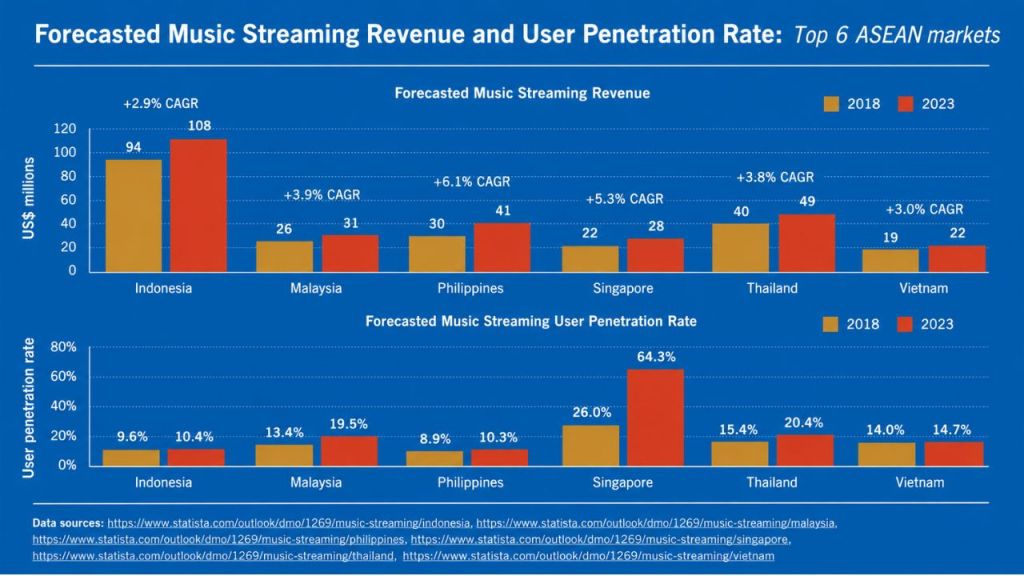
©Forecasted music streaming revenue and user penetration across six major ASEAN markets. Source: Piyapong Muenprasertdee, Overview of Southeast Asian Music Landscape, Fungjai Co., Ltd., Version 1.6 (2021)

Unlike more established music markets, ASEAN is still defining its place on the global stage. Yet many of the foundations for a thriving music industry are already in place: a vast audience, a digitally connected population and a rapidly evolving creative sector. The region is no longer simply an emerging market, it is becoming an increasingly influential cultural force.

Many Voices, One Region

If there is one thing that sets Southeast Asia apart, it is its diversity. Unlike South Korea, where K-pop has become a globally recognised cultural export, ASEAN cannot be defined by a single genre, language or industry. Every country has developed its own musical identity, influenced by different histories, traditions and audiences. Rather than speaking with one voice, the region thrives through the coexistence of many.

This diversity is now finding new audiences. Streaming platforms and social media have made it easier than ever for listeners to discover artists beyond their own borders, allowing music to circulate across Southeast Asia regardless of language. As regional listening habits evolve, success is no longer measured solely by domestic popularity. Increasingly, artists are building audiences across neighbouring countries before reaching the rest of the world.

©Hindia, Indonesia
©MILLI, Thailand
©Cup of Joe, Philippines
©Regina Song, Singapore
©Wren Evans, Vietnam
©Firdhaus, Malaysia

A new generation is already illustrating this shift. Indonesian singer-songwriter Hindia, Thai rapper MILLI, Filipino band Cup of Joe, Singaporean artist Regina Song, Vietnamese singer Wren Evans and Malaysian artist Firdhaus have each built their careers while remaining deeply rooted in their own cultures. Rather than adapting their music to fit international expectations, they embrace their own languages, stories and artistic identities, demonstrating that authenticity resonates far beyond national borders. Instead of producing a single defining sound, Southeast Asia is revealing something far more distinctive: a region where musical diversity itself has become its strongest identity.

Connecting the Dots

If Southeast Asia has never lacked creativity, why has its music remained relatively under the radar internationally?

The answer lies less in the artists than in the industry’s structure. For many years, music industries across the region developed independently, with labels, promoters and artists focusing primarily on their domestic audiences. While talent was abundant, opportunities to connect across borders remained limited.

©ASEAN's demographic and economic weight compared with its share of the global music market. Source: Piyapong Muenprasertdee, “How Can We Create a More Sustainable Live Music Ecosystem for ASEAN?”

The gap is striking. ASEAN accounts for 8.4% of the world’s population and 3.8% of global GDP (Gross Domestic Product), yet it generates only 1.4% of global recorded music revenues. The challenge, therefore, is not a lack of talent or audiences, but transforming this potential into a stronger and more connected music industry.

That landscape is beginning to change. Stronger regional collaborations, showcase festivals, professional networks and export initiatives are helping connect artists with managers, promoters, festivals and media from across Asia and beyond. Rather than treating each national scene as a separate market, these initiatives encourage the region to grow collectively.

©AXEAN Festival

In the next article, we’ll take a closer look at one of the initiatives helping shape this transformation: AXEAN, a showcase festival bringing together artists and music professionals from across Southeast Asia and the world.

This article is based on materials and local industry insights provided by Piyapong Muenprasertdee as part of the Across the SEA media collaboration project curated by Las Olas Agency.
*Piyapong Muenprasertdee — Co-founder of Fungjai, Bangkok Music City and AXEAN Festival.

error: Content is protected !!
Retour en haut